
Why Salsa Is One of the Hardest Condiments to Scale Consistently
Salsa looks forgiving. It’s chopped vegetables, acid, salt, maybe heat. Most people assume if it tastes good in the kitchen, it will taste good on shelves. That assumption is wrong – and it’s why salsa quietly breaks more food businesses than almost any other condiment.
This guide explains why salsa is uniquely difficult to scale, even compared to sauces and dressings, and what recipe creators, artisanal producers, and food brands underestimate when moving from small batches to commercial production. You’ll walk away understanding the real constraints behind texture, safety, shelf life, and consistency – long before branding or distribution matter.
The Illusion of Simplicity: Why Salsa Is Deceptively Complex
At a glance, salsa appears easier than emulsified sauces or cooked condiments. No cream. No eggs. Often no heat processing. But that’s exactly the problem.
Salsa is a heterogeneous product:
- Solids suspended in liquid
- Variable particle sizes
- Fresh ingredients with inconsistent moisture and pH
From a production standpoint, that combination is unstable by default.
Key challenge: salsa doesn’t behave like a liquid or a solid. It behaves like both – badly.
Texture Is Not Just a Recipe Issue – It’s a Systems Issue
Chunk Size Variability Compounds at Scale
In a home kitchen, you can eyeball dice size. In commercial production, even small deviations compound into major problems:
- Large chunks clog filling systems
- Fine particles settle, creating watery tops and dense bottoms
- Mixed particle sizes cause inconsistent fill weights
The result? Two jars from the same batch that look and feel different.
Consistency is not just a sensory issue. Retailers reject products with visible separation, and consumers associate it with spoilage – even when it’s technically safe.
Why “Just Blend It More” Fails
Over-blending solves flow issues but destroys the product’s identity. Salsa buyers expect texture. Smooth salsa competes in a different category entirely.
This forces producers into a narrow operational window where:
- Chunks are large enough to signal freshness
- Small enough to move predictably through equipment
At a commercial scale, maintaining that balance requires more than knife skills – it requires process control.
Acid, pH, and the Food Safety Tightrope
Fresh Ingredients Create Fresh Risks
Most salsas rely on acidification rather than full thermal processing. That puts them under the category of acidified foods, which are regulated differently than shelf-stable sauces.
According to the U.S. Food and Drug Administration, acidified foods must consistently maintain a pH of 4.6 or below to inhibit pathogens like Clostridium botulinum. Sounds simple – until you scale.
Here’s where things break:
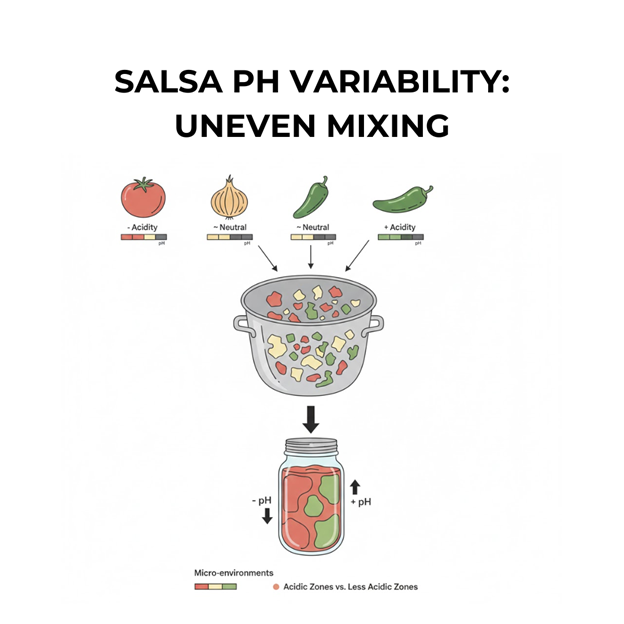
- Tomatoes vary in acidity by season and variety
- Onions and peppers dilute acid unpredictably
- Uneven mixing creates micro-environments with unsafe pH
In small batches, this risk is manageable. At scale, variability becomes systemic.
Separation Is a Visual Problem With Commercial Consequences
Consumers forgive separation in vinaigrettes. They do not forgive it in salsa.
Why Separation Happens Faster at Scale
- Mechanical agitation introduces air
- Larger batch sizes increase settling time
- Inconsistent fill speeds disrupt solid distribution
Once jars sit on a pallet or in transit, gravity does the rest.
The uncomfortable truth: many “recipe fixes” for separation fail because the root cause isn’t formulation – it’s how the product is handled between cooking and sealing.
At this stage, producers often encounter the limitations of manual or semi-manual filling. This is where commercial operations begin evaluating packaging solutions for salsa – not as a growth flex, but as a consistency safeguard.
That reference belongs here because packaging is the last chance to control distribution of solids before the product reaches the shelf.
Shelf Life Isn’t About Time – It’s About Oxygen and Handling
Oxygen Is Salsa’s Silent Enemy
Salsa deteriorates primarily due to:
- Oxidation (color fading, flavor loss)
- Microbial growth from contamination points
- Enzyme activity from fresh produce
Each additional manual step – ladling, transferring, capping – increases exposure.
Studies summarized by the Institute of Food Technologists consistently show that oxygen control and seal integrity are among the strongest predictors of shelf stability in fresh-style products.
This is why salsa brands often see:
- Acceptable shelf life in testing
- Rapid quality decline in real distribution
The gap between lab results and retail reality is where most failures happen.
Why Salsa Is Harder Than Dressings or Sauces
Let’s be blunt: many food entrepreneurs start with salsa because it seems easier than emulsions or cooked sauces. That logic is backwards.
| Product Type | Primary Challenge | Predictability |
| Ketchup | Viscosity control | High |
| Salad dressing | Emulsion stability | Medium |
| Salsa | Particle distribution + safety | Low |
Salsa combines fresh ingredients, solids, acidification, and minimal processing – a worst-case scenario for scalability.
The Scaling Inflection Point Most Producers Miss
There’s a moment every successful salsa maker hits where:
- Demand increases
- Quality complaints appear
- Labor costs spike
- Rework and waste creep in
Many try to fix this with more staff or tighter recipes. That rarely works.
The real inflection point is process design:
- How ingredients are mixed
- How solids are kept in suspension
- How filling and sealing happen consistently at speed
Ignoring this doesn’t just slow growth – it actively damages brand trust.
What Successful Salsa Brands Do Differently
They stop treating salsa like a recipe and start treating it like a system.
That means:
- Designing recipes for scale, not adapting later
- Validating pH and distribution continuously
- Reducing manual handling wherever possible
- Accepting that packaging is part of product quality
This mindset shift – not a single ingredient or trick – is what separates regional successes from brands that quietly disappear.
Conclusion: Salsa Rewards Precision, Not Optimism
Salsa isn’t hard to make. It’s hard to make the same way, every time, at scale.
If there’s one takeaway, it’s this: the challenges of salsa production are not solved in the kitchen. They’re solved where recipe, process, safety, and packaging intersect.
If you found this guide useful, consider sharing it with a fellow producer – or exploring deeper resources on scaling fresh condiments responsibly.